

As the 2024 Academy Awards approach, the standout film, ‘Oppenheimer’, pays homage to one of the most significant scientific endeavors of the 20th century. Having clinched five Golden Globe Awards and receiving 13 Oscar nominations, ‘Oppenheimer’ is not just a critical darling, but also a hit among viewers, maintaining an audience rating above 90% on Rotten Tomatoes – a feat much harder than it sounds!
For those in the water treatment industry, the film may hold special significance. Not only are many of our industry greats connected to Los Alamos, but the genesis of nuclear energy, a field deeply intertwined with water purification and management, can trace its origins to Oppenheimer’s daring project as well.
Los Alamos has been a cradle of innovation, where Nobel laureates and brilliant minds like those portrayed in the movie collaborated to unlock the mysteries of the atom. This legacy continues today, as Los Alamos National Laboratory delves into multidisciplinary research, enhancing our understanding of everything from national security to renewable energy and, notably, water treatment technologies.
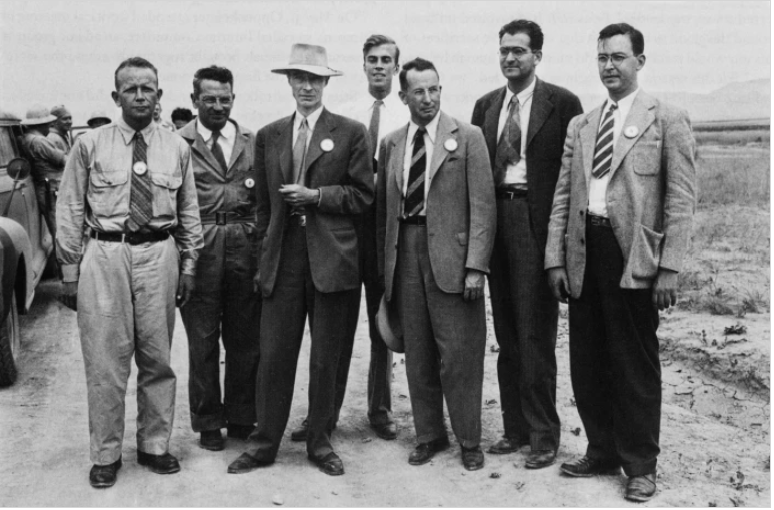
And as I have recently learned, some of the brilliant minds who pioneered our very own water treatment industry have roots in Los Alamos, too.
Les Norman: Growing Up in Los Alamos
Les Norman, founder of IWE and 2023 recipient of the AWT Ray Baum award, offers a unique perspective on the intersection of family legacy and scientific achievement at Los Alamos. Both of his parents had contributed to the groundbreaking work there—his father as part of the Manhattan Project, and his mother in the aftermath, analyzing soil samples to gauge the environmental impact of nuclear tests.
Growing up, Les was immersed in a community of intellect and innovation. His parents and their peers were not just participants in historic scientific endeavors – they were pioneers who laid the groundwork for future discoveries. After graduating from college, Les joined a public electric utility company, specializing in the study of silicate in groundwater. His professional path led him to collaborate with Los Alamos, a place that held profound significance.
Reflecting on the movie ‘Oppenheimer’, Les believes that while the film successfully captures the intensity of the era, it could have focused even more on the collaborative spirit and collective brilliance that defined Los Alamos. In his view, the true marvel was not just the achievements of a few prominent figures, but the synergy of many exceptional minds coming together to push the boundaries of what was known and achievable.
AFA’s Connection to Los Alamos
From 1948 to 1954, my grandfather, Dr. Arthur Freedman, Ph.D., served as a Research Associate at the University of New Mexico and the Los Alamos Scientific Laboratory. He was quite productive during this time, focusing on analytical applications of radiochemistry. Notably, in 1951, he was the main author on the article, “Investigation of Low-Level Counting Techniques,” and he co-authored another titled, “Some New Isotopes of Antimony and Tin.”
My grandpa arrived at Los Alamos after WWII, just one year after the Manhattan project was officially ended. I like to imagine what he thought of his time there. He revered Albert Einstein, who was a well-known pacifist by that time. I wonder, like Einstein, would he have had struggled with the knowledge that he was working on such controversial grounds, or – like so many others that came before him – would he have been too enamored by the prospect of contributing to new science to dwell on the more catastrophic aspects of its history?
Whatever he may have felt at the time, one thing is certain: the water treatment industry – and my family – would not be what it is today if not for the scientists and their loved ones who called Los Alamos home.
Los Alamos and the Water Treatment Industry
The Manhattan Project and subsequent research at Los Alamos catalyzed the nuclear power industry, which, in turn, revolutionized water treatment processes. Nuclear reactors require ultra-pure water for cooling and steam production, underscoring the symbiotic relationship between nuclear science and water treatment.